
Beyond the Active Ingredient | What Pharmacists Should Know About Red No. 3, Excipients, and Patient Values
By Dr. Jesica Mills Thomason, PharmD, ND, MBA, RPh
When patients ask what is in a medication, they may be asking about far more than the active drug. A dye may be linked to a prior reaction; lactose may worsen gastrointestinal symptoms; and gelatin or alcohol may conflict with religious, cultural, vegetarian, or vegan practices. The pharmacist’s task is product-specific: identify the exact formulation, explain what the evidence shows, and help the patient find an acceptable option without interrupting necessary therapy.
Red No. 3: What the FDA action actually means
On January 15, 2025, the U.S. Food and Drug Administration (FDA) revoked the authorization for FD&C Red No. 3 dye to be used in food and ingested drugs. This synthetic, petroleum-derived coloring has been used for decades to give products a bright, cherry red color. Food manufacturers will have until January 15, 2027, to reformulate their products. Manufacturers of ingested drugs will have until January 18, 2028. A product manufactured before its applicable effective date may still appear in commerce afterward, so pharmacists should expect a transition period rather than an overnight disappearance from shelves.
The regulatory rationale deserves careful wording. The FDA acted under the Delaney Clause of the Federal Food, Drug, and Cosmetic Act, which prohibits authorization of an additive found to induce cancer in humans or animals. High-dose studies looking at this excipient found thyroid tumors in male rats through a rat-specific hormonal mechanism. The FDA states that this mechanism does not occur in humans, that typical human exposure is substantially lower, and concludes that available evidence does not show Red No. 3 causes cancer in humans. Therefore, the action is a matter of statutory application—not a new FDA conclusion that ordinary human exposure has been shown to cause cancer. However, the FDA announced their intention to revoke the use of this product as far back as 1992, but declined to take action due to the resources required.
Red No. 3 may appear as FD&C Red No. 3, Red 3, Red Dye 3, or erythrosine. It has been used in foods such as candies, baked goods, frostings, frozen desserts, and in some medications, often giving products a distinct bright red color The order does not apply to every red-colored item, and color alone cannot identify the dye used. Patients and pharmacy staff must read the ingredient statement or product labeling to know what dye was specifically used.
Although substituting an inactive ingredient is generally considered a major change, replacing a color additive is believed to be unlike to adversely affect the quality, purity, or potency of the finished drug. Therefore, the FDA recommended that drug manufacturers submit a “Changes Being Effected in 30 Days” notification, as opposed to waiting for full prior approval. With a nearly three-year window to reformulate, and a relatively small number of products affected (primarily liquid cold syrups and chewable tablets), this change is not anticipated to lead to widespread drug shortages.
Why “inactive” ingredients still matter
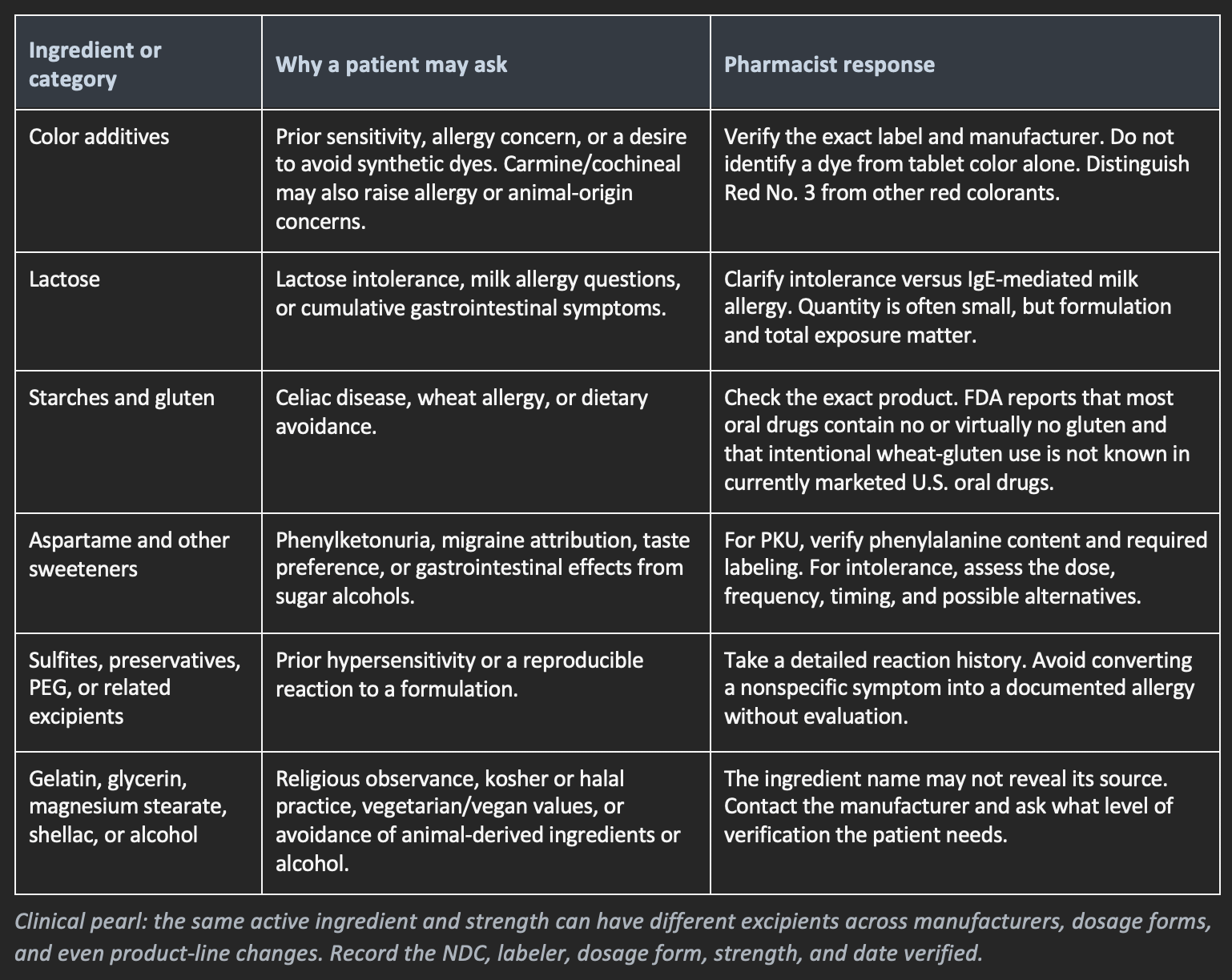
Excipients provide structure, stability, preservation, flavor, color, controlled release, solubility, or ease of manufacturing. Most excipients are well tolerated at the quantity used during the manufacturing process. Still, “inactive” describes the ingredient’s intended therapeutic role; it does not guarantee that the ingredient is clinically or personally irrelevant to every patient.
A 2019 analysis of oral solid medications found a median of eight inactive ingredients per tablet or capsule and substantial formulation variation among products containing the same active ingredient and strength. That variability is important at the counter: a patient who cannot tolerate one manufacturer’s formulation may tolerate another, but the pharmacist must verify rather than assume.
Where pharmacists can verify ingredients
- Start with the physical product. For nonprescription drugs, review the Drug Facts panel and the inactive-ingredients section, often on the back of the packaging. For prescription medication, the Description section of official labeling geerally lists ingredients. Match the bottle, package, NDC, labeler, strength, and dosage form.
- Search DailyMed by drug name, NDC, or labeler. DailyMed provides the most recent labeling submitted to FDA and currently in use. It is highly useful, but it is not a complete listing of every FDA-regulated product. Confirm that the label displayed matches the product in hand.
- Use Drugs@FDA for FDA-approved labeling and regulatory history when applicable. Archived labels can also help explain why a patient’s old and new tablets differ, but the current dispensed NDC remains the most relevant formulation.
- Use FDA’s Inactive Ingredient Database (IID) for context—not as proof of a specific product’s composition. The IID shows excipients used in FDA-approved drug products by route and dosage form, and may include maximum potency or daily-exposure information. It does not identify the proprietary formulation linked to a particular NDA or ANDA, and it excludes some categories, including biologics and OTC monograph products.
- Contact the manufacturer’s medical-information or product-quality department when source matters. Ask a narrow, answerable question: Is the gelatin porcine, bovine, fish, or synthetic? Is the glycerin plant- or animal-derived? Is the alcohol present in the finished product, and at what concentration? Has the formulation changed? Request a written response or case number when possible.
- For food additives, use the FDA’s Substances Added to Food inventory and color-additive resources to understand regulatory status. These tools supplement—not replace—the ingredient label for a specific packaged food.
Cultural and religious considerations: ask, do not assume
Medication acceptability is an individual decision. Two patients from the same faith tradition may interpret gelatin, alcohol, animal-derived excipients, medical necessity, or degree of processing differently. Vegetarian and vegan practices also vary. A pharmacist should not decide whether a product is halal, kosher, vegetarian, vegan, or religiously permissible solely from an ingredient name—or from assumptions about the patient.
A respectful opening is simple: “Are there any ingredients you avoid for allergy, intolerance, religious, cultural, or personal reasons?” If the answer is yes, determine the patient’s threshold. Some patients require formal certification; others need confirmation that an ingredient is not porcine-derived; others accept an otherwise prohibited ingredient when no reasonable alternative exists. If the decision involves religious interpretation, offer verified product information and invite the patient to consult a trusted faith leader. The pharmacist’s role is to make the clinical choices and ingredient facts available, not to determine belief.
These conversations are also adherence interventions. Research has documented that patients often discontinue medications due to concerns of pork- or beef-derived gelatin and other inert ingredients. Proactively addressing the concern can preserve trust and prevent a patient from silently abandoning treatment.
A practical pharmacy workflow
- Ask the reason for avoidance and characterize any prior reaction: symptom, timing, dose, formulation, treatment required, and reproducibility.
- Identify the exact product using NDC, manufacturer or labeler, dosage form, strength, lot if relevant, and current labeling.
- Separate three questions: Is the ingredient present? What is its source or quantity? Is it likely to explain the patient’s concern?
- Search for an alternative manufacturer, dosage form, strength combination, dye-free product, or compounded preparation when clinically and economically reasonable.
- Check coverage, availability, release characteristics, and therapeutic equivalence before switching. Never substitute a formulation in a way that changes drug release or clinical effect.
- Document the verified formulation and the patient’s stated preference. Avoid broad allergy entries such as “all dyes” unless that is supported by the history.
- Reverify after manufacturer changes. A note that was accurate last year may not describe today’s product.
The operational opportunity
Additive questions are often treated as time-consuming exceptions, yet they reveal an opportunity for differentiation. Pharmacies can maintain a brief verification template, flag preferred NDCs when systems allow, train staff to locate inactive ingredients, and develop a manufacturer-contact pathway. Purchasing teams and distribution partners can support this work by preserving visibility into manufacturer and NDC changes and by helping pharmacies locate alternative products when formulation matters.
The goal is not to label every additive as dangerous or to promise that every preference can be accommodated, but to replace guessing with verification. As Red No. 3 leaves foods and ingested medications on two different timelines, pharmacists are available to translate a regulatory headline into calm, individualized, and clinically sound care.
Key takeaways
- FDA’s Red No. 3 action is based on the Delaney Clause; FDA states available evidence does not show the dye causes cancer in humans.
- The reformulation deadlines are January 15, 2027, for food and January 18, 2028, for ingested drugs.
- Inactive ingredients can vary among products with the same active ingredient and strength.
- DailyMed and current product labeling are the best starting points for a specific medication; FDA’s IID is a contextual development database, not a product-level ingredient checker.
- Culturally responsive counseling begins with an open question and ends with verified facts, shared decision-making, and documentation.
References
- Babos, M. B., Perry, J. D., Reed, S., Bugariu, S., Hill-Norby, C., & Saseen, J. J. (2021). Animal-derived medications: Cultural considerations and available alternatives. Journal of Osteopathic Medicine, 121(4), 361-370. https://doi.org/10.1515/jom-2020-0052
- National Library of Medicine. (2026). DailyMed. https://dailymed.nlm.nih.gov/dailymed/
- Reker, D., Blum, S. M., Steiger, C., Anger, K. E., Sommer, J. M., Fanikos, J., & Traverso, G. (2019). “Inactive” ingredients in oral medications. Science Translational Medicine, 11(483), eaau6753. https://doi.org/10.1126/scitranslmed.aau6753
- Sattar, S. P., Ahmed, M. S., Madison, J., Olsen, D. R., Bhatia, S. C., Ellahi, S., Majeed, F., Ramaswamy, S., Petty, F., & Wilson, D. R. (2004). Patient and physician attitudes to using medications with religiously forbidden ingredients. Annals of Pharmacotherapy, 38(11), 1830-1835. https://doi.org/10.1345/aph.1E001
- U.S. Food and Drug Administration. (2017). Medications and gluten. https://www.fda.gov/drugs/buying-using-medicine-safely/medications-and-gluten
- U.S. Food and Drug Administration. (2025, January 15). FDA to revoke authorization for the use of Red No. 3 in food and ingested drugs. https://www.fda.gov/food/hfp-constituent-updates/fda-revoke-authorization-use-red-no-3-food-and-ingested-drugs
- U.S. Food and Drug Administration. (2026). FD&C Red No. 3. https://www.fda.gov/industry/color-additives/fdc-red-no-3
- U.S. Food and Drug Administration. (2026). Using FDA’s Inactive Ingredient Database: Best practices and considerations. https://www.fda.gov/media/194078/download

